Blog
Boom Length Explained: How to Calculate Reach for Your Crane Job
Learn how crane boom length and radius determine reach and capacity, and how to estimate what your lift will need before you request a quote.
Crane boom length calculation comes down to one relationship: how far the boom must extend and tilt to get your load from the crane’s position to the pick or set point, and how much lifting capacity remains available at that reach. There is no single formula that works across every crane, every job site, and every configuration. Instead, boom length and working radius are worked out together, checked against the specific crane’s load chart, and adjusted for obstructions, ground conditions, and rigging.
This guide explains the concepts behind boom length and reach so you can walk into a quote conversation with a realistic picture of what your job needs. For a deeper look at load charts themselves, see what is a load chart and how do you read one. If you are still deciding between crane categories, our guide to Mobile Crane vs Crawler Crane covers that first-level decision.
Key Takeaways
– Boom length and working radius work together to determine reach, and reach is not the same as capacity.
– Capacity drops as radius increases, even with the same boom length, because of leverage on the crane’s structure and counterweight.
– Boom extensions and jibs add reach but reduce the load the crane can lift at that configuration.
– Obstructions like buildings and power lines limit both the boom angle you can use and where the crane can physically sit, so they must factor into planning early.
– Any reach or capacity figure from a general calculation must be confirmed against the actual load chart for the specific crane before the lift.
What Boom Length and Radius Actually Mean
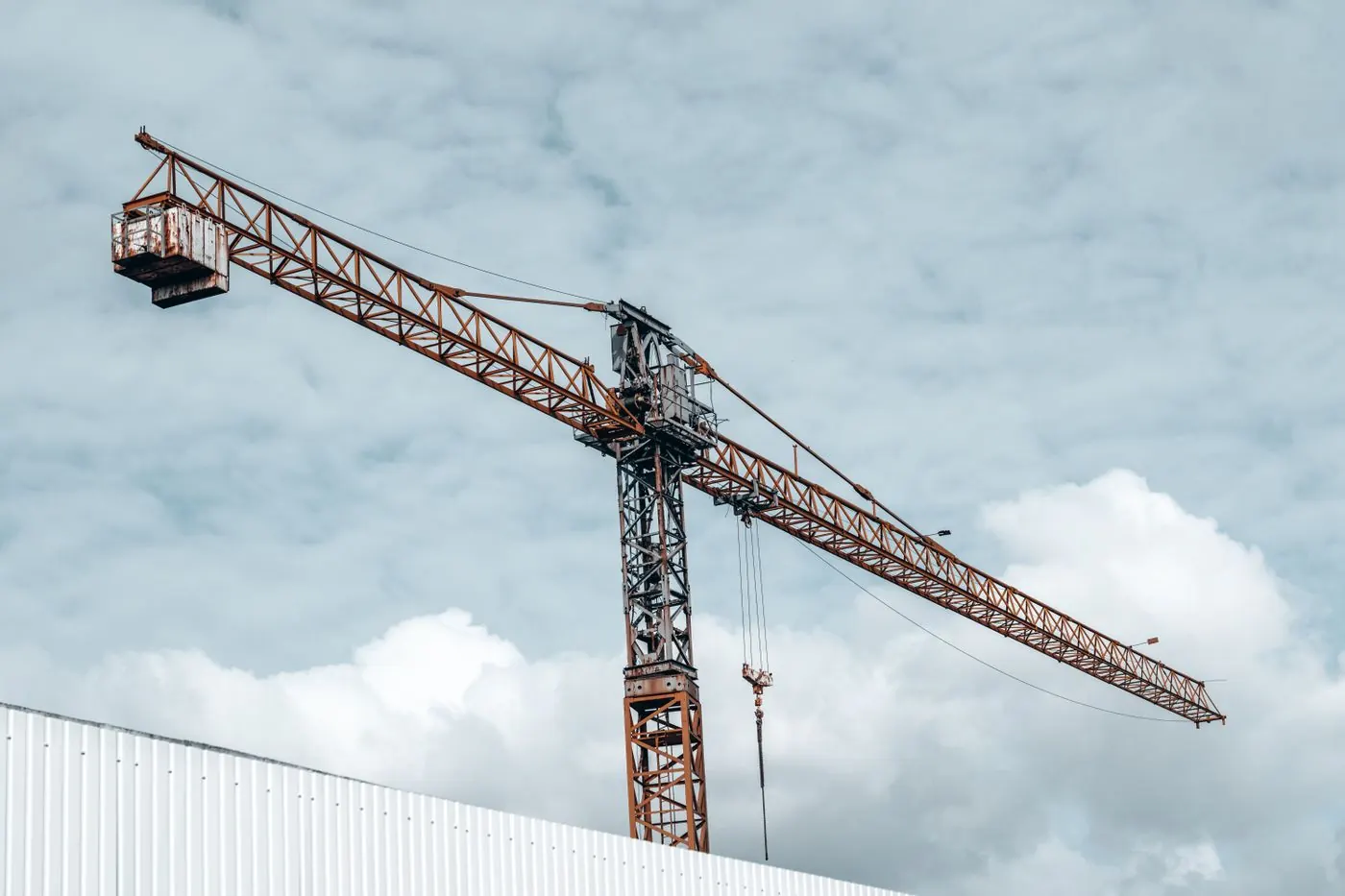
Boom length is the physical length of the crane’s boom, measured from the boom foot (where it pivots near the crane’s base) to the tip. Working radius is the horizontal distance from the crane’s center of rotation to the load, measured along the ground. These two numbers are related but not interchangeable.
A longer boom does not automatically mean a longer radius, because the boom’s angle changes the relationship. A boom raised to a steep angle, close to vertical, keeps the load close to the crane even if the boom itself is long. Lower the same boom toward horizontal, and the radius grows substantially, often approaching the boom’s full length. This is why crane operators and planners talk about boom angle and radius together, not boom length alone.
How Reach Is Calculated From Crane Position to Load Position
Reach, in practical terms, is the horizontal and vertical distance the boom tip has to cover to place the load exactly where it needs to go. Planning starts by identifying two points: where the crane will be set up, and where the load needs to be picked from and set down. The horizontal distance between the crane’s center of rotation and the load position becomes the working radius. The vertical distance, from the ground (or the crane’s pivot height) up to the pick or set point, is the lift height.
Boom length and angle are then set so the boom tip reaches both the required radius and the required height at the same time. This is a geometric relationship, and while it can be expressed mathematically for a specific boom configuration, the practical answer always comes from the manufacturer’s range diagram for that exact crane and boom setup, not a general trigonometric estimate. Range diagrams show, for each boom length and angle combination, exactly what radius and tip height the crane achieves. Planners use these diagrams rather than calculating from scratch, because they account for the boom’s actual deflection under load and the crane’s specific geometry.
Why Capacity Drops as Radius Increases
This is the part of boom length planning that catches people off guard: the same crane, with the same boom length, can lift dramatically less weight as the radius increases. This happens because of leverage. As the load moves farther from the crane’s center of rotation, it exerts more turning force (moment) on the crane’s structure and counterweight system. The crane’s rated capacity at any given radius reflects the maximum load it can hold without exceeding structural limits or tipping.
This relationship is documented on the crane’s load chart, which lists capacity at each combination of boom length and radius. A crane rated to lift a substantial load at a short radius might only be rated for a fraction of that weight once the radius extends to reach a target further away. This is precisely why boom length and radius cannot be chosen in isolation from the load weight. A job that needs both long reach and heavy capacity often requires a larger crane class than a job with the same load weight at a short radius. Our equipment page lists the fleet available across different capacity classes for exactly this reason.
The Role of Boom Extensions and Jibs
When a job needs more reach than the main boom alone provides, cranes can add a boom extension (a fixed additional boom section) or a luffing or fixed jib (an angled extension at the boom tip). Both add length and therefore reach, but both also reduce the crane’s rated capacity at any given radius compared to using the main boom alone.
Extensions and jibs are lighter than the main boom sections, which is what lets them add reach without proportionally adding as much dead weight. But they also apply their own leverage, and load charts treat jib and extension configurations as distinct entries with their own capacity limits. A job that looks feasible with the main boom might need a jib to reach a specific point, and that jib configuration needs to be checked against its own line on the load chart, not assumed to carry the same capacity as the main boom configuration.
Why Obstructions Constrain Boom Angle and Crane Positioning
Site obstructions are one of the most common reasons a theoretical boom length calculation does not match what actually happens on site. Buildings, walls, scaffolding, existing structures, and overhead power lines all limit where the crane can be positioned and what boom angles are usable.
A building between the crane and the load forces either a higher boom angle to clear the obstruction, a repositioned crane setup, or both. Raising the boom angle to clear an obstruction reduces the working radius for a given boom length, which can push the crane’s required position closer to the load, which then runs into ground access or clearance limits near the structure itself. Power lines add a regulatory dimension: minimum clearance distances apply regardless of the geometric solution, and boom paths need to be planned to maintain that clearance throughout the lift, not just at the final position.
This is why experienced planners walk the site or review detailed site drawings before finalizing boom length and crane class, rather than relying on straight-line distance measurements from a satellite image.
Practical Guidance for Estimating Reach Before Requesting a Quote
Before contacting a crane rental company, gathering a few pieces of information speeds up the quoting process and improves the accuracy of the crane recommendation.
Start with the load weight, including rigging hardware, since this is the anchor figure the load chart is built around. Next, measure or estimate the horizontal distance from where the crane can realistically be set up to where the load needs to be picked and placed, this becomes your working radius estimate. Then note the vertical lift height, from ground level to the pick point and separately to the set point, since both matter if they differ. Finally, document any obstructions along the boom’s likely path, including nearby structures, walls, and overhead lines, along with their approximate height and distance.
With these four pieces, radius, height, load weight, and obstructions, a crane provider can match your job to the right crane class and boom configuration and confirm capacity against the actual load chart, which is the only reliable final answer. General calculations are useful for early planning, but they are not a substitute for that final load chart check.
FAQ
Does a longer boom always mean more reach?
Not necessarily. Reach depends on boom length and boom angle together. A long boom held at a steep angle can have less horizontal reach than a shorter boom lowered closer to horizontal.
Why does the same crane show different capacities for the same load?
Capacity changes with working radius, not just boom length. As the load moves farther from the crane’s center of rotation, the load chart shows a lower rated capacity at that radius, even with an unchanged boom length.
Can I calculate the exact boom length I need myself?
You can estimate working radius and lift height using site measurements, which helps you have an informed conversation. But the final boom length, angle, and configuration should always be confirmed against the specific crane’s load chart by the rental provider, since deflection, jib use, and rigging all affect the real-world figures.
How do power lines affect boom length planning?
Power lines impose minimum clearance distances that the boom must maintain throughout the entire lift path, not just at the final position. This can force a different crane position, a different boom angle, or a different crane class than a purely geometric reach calculation would suggest.
Conclusion
Boom length calculation is really a planning exercise built around four factors: how far the load is from where the crane can sit, how high it needs to travel, how much it weighs, and what stands in the way. Understanding how radius and angle interact, and how capacity falls off as radius grows, helps you describe your job accurately and avoid surprises once a load chart is checked. For a job-specific assessment, review the fleet options available across capacity classes and reach out with your site details so the boom length and configuration can be confirmed against the actual crane you will use.
Red Tiger Heavy Equipment Rental L.L.C. has supported mobile crane operations across the UAE since 2008, with a fleet ranging from 8 to 500 tonnes.

Faizan Ahmed
Related Articles
All articles Blog
Blog Crane Rental for Ports and Logistics Operations in the UAE
Mobile crane rental for UAE ports and logistics: breakbulk cargo, warehouse installs, and free zone lifts that complement fixed port…
Read article Blog
Blog Daily vs Weekly vs Monthly Crane Rental Rates: Which Is Cheaper?
Compare daily, weekly, and monthly crane rental rates in the UAE, including mobilisation costs, to find the true cheapest option…
Read article Blog
Blog Crane and Rigging Support for Hospitality and Hotel Construction Projects
How hotel and resort builds in the UAE use crane rental for facade, MEP, pool, and waterfront lifts without slowing…
Read articleReady to Discuss Your Project?
Share your load, location and dates. Our team responds to every enquiry within 2 hours.