Blog
Mobile Crane Types Explained: All-Terrain, Rough-Terrain, Truck-Mounted, and Carry Deck
Compare all-terrain, rough-terrain, truck-mounted, and carry deck mobile cranes: capacity ranges, best use cases, and pros and cons.
There are four main types of mobile cranes used on job sites today: all-terrain cranes, rough-terrain cranes, truck-mounted cranes, and carry deck cranes. Each one is built for a different combination of ground conditions, travel distance, and lift capacity, and picking the wrong type usually means paying for capability you don’t need or missing capability you do need. This guide breaks down what separates each type, where it performs best, and what to weigh before you book one.
Key Takeaways
– All-terrain cranes travel on highways and work off-road, making them the most versatile choice for mixed-site projects.
– Rough-terrain cranes are built for off-road-only use on uneven or soft ground and are typically the fastest to set up on a single job site.
– Truck-mounted cranes ride on a standard commercial chassis, so they move between job sites quickly without a separate transport truck.
– Carry deck cranes are compact, offer 360-degree rotation, and are suited to tight indoor or industrial spaces where larger cranes cannot maneuver.
All-Terrain Cranes: Highway Travel Meets Off-Road Capability
All-terrain cranes are the most versatile mobile crane type because they combine highway travel speeds with genuine off-road performance on a single chassis. A single all-terrain unit can drive itself from a paved road directly onto a rough or unpaved site without needing to be loaded onto a separate trailer, which saves mobilization time on projects that span multiple locations.
Typical capacity range: Roughly 40 to 500+ tons, depending on the model and number of axles.
Typical use case: Infrastructure projects, industrial plant work, and any job that requires moving between multiple sites or traveling long distances on public roads before reaching the lift location.
Pros:
– Multi-axle steering allows tight maneuvering in congested areas.
– Full highway travel speed reduces transport costs between jobs.
– Capable of working on moderately uneven terrain after arrival.
Cons:
– Higher rental and operating cost than smaller crane types.
– Requires more setup space for outriggers than a compact carry deck crane.
view all-terrain crane specifications
Rough-Terrain Cranes: Built for Uneven, Off-Road Sites
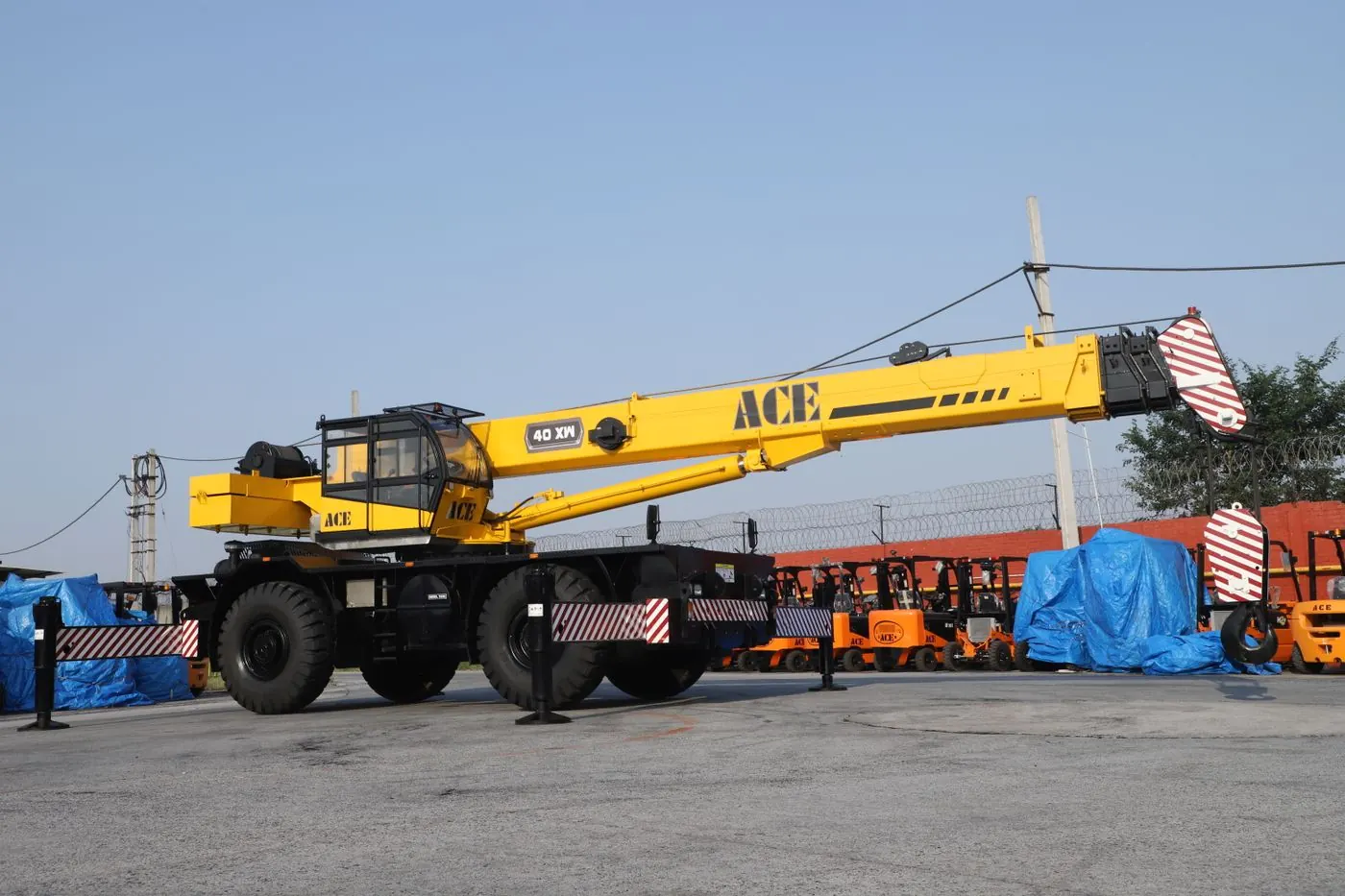
Rough-terrain cranes are purpose-built for off-road conditions and are not intended for highway travel, which is the key distinction from all-terrain models. They run on large rubber tires designed for soft or uneven ground and are operated from a single cab that handles both driving and lifting functions.
Typical capacity range: Roughly 15 to 130 tons.
Typical use case: Construction sites, quarries, and oilfield locations where the crane stays on one site for the duration of the job and the ground is unpaved, sloped, or soft.
Pros:
– Strong off-road traction and stability on uneven ground.
– Compact turning radius compared to larger all-terrain units.
– Single-cab operation simplifies setup on remote sites.
Cons:
– Must be transported to site on a separate trailer, which adds mobilization time and cost.
– Not legal or practical for direct highway travel.
Truck-Mounted Cranes: Fast Road Travel on a Commercial Chassis
Truck-mounted cranes have a crane assembly mounted on a standard commercial truck chassis, which means the unit can be driven at normal highway speeds without a separate transport vehicle. This makes them a practical choice for contractors who need to move a crane between several short jobs in a single day.
Typical capacity range: Roughly 20 to 50 tons, though larger truck-mounted units exist for specific applications.
Typical use case: Utility work, short-duration lifts, and projects where the crane needs to reach several sites in a short timeframe, such as pole-setting or material placement along a road corridor.
Pros:
– Travels at full highway speed, reducing transport logistics.
– Familiar truck chassis simplifies driver licensing and road use in many jurisdictions.
– Efficient for short, frequent lifts across multiple locations.
Cons:
– Lower off-road capability than rough-terrain or all-terrain cranes.
– Lower maximum capacity limits use on heavy industrial lifts.
explore mobile crane rental options
Carry Deck Cranes: Compact Lifting for Tight Spaces
Carry deck cranes are small, four-wheeled cranes with a flat deck and a boom that rotates a full 360 degrees, which makes them well suited to indoor facilities, tight industrial yards, and warehouse settings where larger cranes simply cannot fit. Their compact footprint is the defining advantage: what they give up in capacity, they make up for in maneuverability.
Typical capacity range: Roughly 3 to 25 tons.
Typical use case: Machinery installation, plant maintenance, and warehouse or factory lifts where space is limited and the crane needs to reposition frequently within a small area.
Pros:
– Full 360-degree rotation in a compact frame.
– Fits through standard doorways and narrow aisles that block larger cranes.
– Easy to transport on a standard trailer.
Cons:
– Limited lift capacity compared to all other mobile crane types.
– Not suited for outdoor sites with uneven or soft ground.
Comparing the Four Mobile Crane Types
| Crane Type | Typical Capacity | Travel Capability | Best For |
|---|---|---|---|
| All-Terrain | 40-500+ tons | Highway and off-road | Multi-site projects, industrial lifts |
| Rough-Terrain | 15-130 tons | Off-road only | Single-site work on uneven ground |
| Truck-Mounted | 20-50 tons | Highway (fast) | Short, frequent lifts across sites |
| Carry Deck | 3-25 tons | Trailer transport | Tight indoor or industrial spaces |
Matching capacity and mobility to the actual job conditions, rather than defaulting to the largest available crane, is usually the difference between an efficient lift and an overpriced one. If you’re also weighing a mobile crane against a crawler crane for a specific project, see our comparison of a Mobile Crane vs Crawler Crane for guidance on ground bearing pressure and setup time.
FAQ
What is the main difference between an all-terrain crane and a rough-terrain crane?
An all-terrain crane can travel on public highways and then move onto rough ground once it arrives, while a rough-terrain crane is built only for off-road use and must be hauled to site on a separate trailer.
Which mobile crane type is best for a construction site with soft or uneven ground?
A rough-terrain crane is generally the best fit for soft or uneven ground because its tires and undercarriage are designed specifically for off-road stability.
Can a truck-mounted crane handle heavy industrial lifts?
Truck-mounted cranes typically max out around 50 tons, so they are better suited to lighter, more frequent lifts than to heavy industrial work, which usually calls for an all-terrain or larger rough-terrain crane.
Why would a project use a carry deck crane instead of a larger mobile crane?
A carry deck crane is chosen when the job site has tight clearances, such as a warehouse aisle or plant interior, where a larger crane’s footprint and turning radius would not fit.
Choosing the Right Crane for Your Project
The right mobile crane type depends on three factors: how far the crane needs to travel, what the ground conditions look like at the site, and how much lifting capacity the job actually requires. All-terrain cranes cover the widest range of conditions, rough-terrain cranes handle difficult ground best, truck-mounted cranes move fastest between short jobs, and carry deck cranes solve the tight-space problem that larger cranes cannot.
For help matching a crane type to your project’s site conditions and lift plan, browse our full equipment fleet, review our mobile crane rental services, or contact our team to discuss capacity and access requirements.
Red Tiger Cranes has provided mobile crane rental and heavy-lifting services across the UAE since 2008.

Faizan Ahmed
Related Articles
All articles Blog
Blog Crane Rental for Ports and Logistics Operations in the UAE
Mobile crane rental for UAE ports and logistics: breakbulk cargo, warehouse installs, and free zone lifts that complement fixed port…
Read article Blog
Blog Daily vs Weekly vs Monthly Crane Rental Rates: Which Is Cheaper?
Compare daily, weekly, and monthly crane rental rates in the UAE, including mobilisation costs, to find the true cheapest option…
Read article Blog
Blog Crane and Rigging Support for Hospitality and Hotel Construction Projects
How hotel and resort builds in the UAE use crane rental for facade, MEP, pool, and waterfront lifts without slowing…
Read articleReady to Discuss Your Project?
Share your load, location and dates. Our team responds to every enquiry within 2 hours.